
Biophilic design seeks to connect our inherent need to affiliate with nature in the modern built environment. An extension of the theory of biophilia, this need is thought to remain instrumental to people’s physical and mental health, fitness, and wellbeing.
Have you noticed the more regularly you are exposed to nature and natural elements, your overall mood lifts? Well, you’re not alone. It is no surprise that if you are in a space for nine-hours of the day, each day, with little exposure to natural lighting or a connection to other natural elements, then productivity, efficiency and morale will rapidly decrease.
The exposure to nature is actually excellent for human health, well-being and overall happiness; even to the extent that spaces with green elements incorporated into them promote prosocial behaviours.
As a result of this, the trend of including natural elements in designs, not just for healthcare, but in residential and commercial properties too, has grown exponentially. This inclusion of natural elements is referred to as biophilic design. So, what exactly is biophilic design and architecture?
Biophilia is the inherent human need to connect and affiliate with the natural world. Biophilic interior design is an extension to this concept and is defined as the implementation of natural materials, natural light, nature views, vegetation and other experiences from the natural environment into the built environment (1).
The biophilic design concept focuses on these aspects of the natural world that have contributed to human health, happiness and productivity in the constant strive to be fit and to survive (2). Another distinctive character of biophilic design and architecture is the significance it has on the incorporation of the overall setting or habitat, and not just simply an isolated single occurrence in the natural environment (2).
The design and construct of the healthcare industry has moved further towards Evidence-Based Design in recent years because of overwhelming research supporting how specific design elements influence and facilitate greater patient experience, care and recovery; resulting in the introduction of biophilic design principles and elements into the healthcare industry.
The main objective of the biophilic design elements in healthcare is to direct patient and staff psychological and physiological responses to their respective spaces, expanding the creation of a more cooperative and supportive healing environment and reducing the amount of time the patient is required to stay.
The benefits of implementing biophilic design and architecture into the designs of healthcare centres, hospitals, clinics and practices are undoubtedly considerable, yet what are the many ways in which the biophilic design concept can be incorporated?
There are six basic principles of biophilic design: Environmental features, natural shapes and forms, natural patterns and processes, light and space, place-based relationships and evolved human-nature relationships (1).
“Environmental features” refers to implementing well-recognised characteristics of nature into the built environment. “Natural shapes and forms” refer to the resistance of using straight lines and right angles, and instead utilising arches, vaults and domes, which creatively reflect botanical environments. The “Natural patterns and processes” is a principle that utilises time, change and transitions to create a unique and varying sensory experience of a space. “Light and space” is a principle which is derived from the understanding of how and why humans react to light in each of its forms and knowing how to use it. “Place-based relationships” refers to the significance of a place being associated to a meaning, whether it be historic, cultural, spiritual, geographical, or ecological. Lastly, the principle of “evolved human-nature relationships” refers to the human’s transformation due to our complicated relationship with nature (1).
hese principles of biophilic design and architecture are implemented into healthcare facilities through the creative inclusion and optimisation of spaces with a human focus, thermal comfort levels, air quality, toxin levels and ventilation, acoustic comfort, improved natural lighting, views into nature both externally and internally, the use of natural materials, textures, patterns and colours, the use of recuperative spaces, and the psychological and physiological effect on the space (4).
With that knowledge, let’s take a look into a world-renowned biophilic architecture case study.
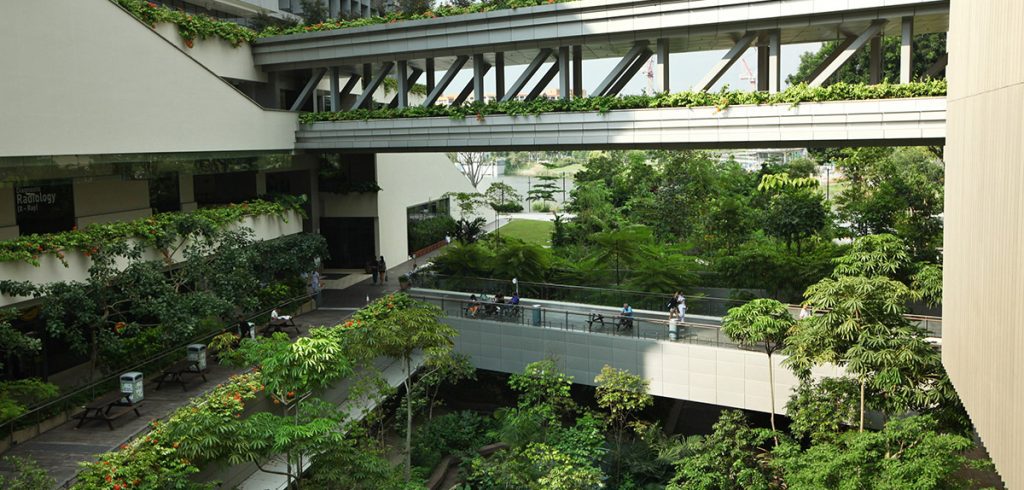
Singapore is home to one of the most famous biophilic design examples, Khoo Teck Puat Hospital. This hospital is no ordinary healthcare facility, in fact, upon first glace you would not even think it was a hospital.
This healthcare space is a 550-bed public hospital built upon 3.5-hectares, located in northern Singapore (5), designed by CPG Consultants for Alexandra Health. The original design brief for this iconic healthcare environment required the design to reflect a hassle-free hospital that facilitates efficiency for both the staff and patients, and also in energy consumption (6). Along with this, the design was also driven by the Ex-CEO’s desire of the hospital to be designed to allow individual’s blood-pressure to lower once they enter the grounds (7).
Needless to say, the final design knocked the original design brief out of the park as the designers and architects produced a healthcare environment that assists patients in forgetting their injury and pain, and improves their recovery time and rate by immersing them into a natural healing environment (7). This is done through the clever creation of an invigorating park-like ambiance for patients, caregivers and the general public by enhancing the views and access to nature; thus, also facilitating a conducive working environment for staff members (7).
So, how exactly was Khoo Teck Puat Hospital designed to reflect the natural environment and what were the biophilic architectural elements and principles incorporated in it’s final, breath-taking design?
The building itself is designed in a V-shaped configuration of blocks which portray a central court. The ‘V’ is designed to open to the north, allowing natural breezes to enter the site, tapping into a natural airflow. This unique building shape not only provides patients with cooling breezes, but also allows them access to natural lighting and views without solar glare or rain (7).
The architecture is also uniquely design to reflect the habitation of a forest. This is achieved through the incorporation of water features, aquatic species, and the introduction of plants to attract birds and butterflies (7). Foliage and greenery are incorporated from the central courtyard of the hospital to the very upper levels of the building, and then down into the open-to-sky basement. This facilitates the perception of the building being entangled and immersed in a large garden. Coupled with this is the inclusion of scented plants on patient balconies, allowing patients to experience the nature from their bedside (7).
The inclusion of a storm-water pond is designed with aquatic plants and clean water to encourage further aquatic habitats (7). Coupled with rooftop gardens which cater to specific patient needs, such a dementia, and a rooftop farm of which holds about 100 species of fruit trees, 50 species of herbs and 50 species of vegetables, an education opportunity is provided for all visitors (7).
Just as much as Singapore’s Khoo Teck Puat Hospital is green, it is also eco-friendly too, which is another large part of biophilic architecture and design. Biophilic design inclusions have saved the facility on major energy costs, and such features have won the hospital a number of green awards since completion (6).
Biophilic design and architecture is of ever-rising importance to our health and well-being in the built environment, especially due to the modern disconnection many have to the natural environment and elements within urbanised areas. Khoo Teck Puat Hospital’s biophilic architecture is a leader in the biophilic design movement, proving the importance of it and the numerous unique creative ways to implement it.
The ability to reduce stress, speed-up recovery times, positively impact behavioural disorders and liven up what is traditionally considered a sterile space are only a few benefits of biophilic design. The recognition of our need to connect with nature also boosts productivity, efficiency, morale and overall service delivery, allowing healthcare practitioners to perform at their optimum level, whilst patients receive their optimum care in a cleverly designed environment.
Did you know we incorporate biophilic design as part of our medical fitouts services? If you would like to discuss how biophilic design can benefit both your staff and patients, contact Interite Healthcare Interiors.