
The decisions made at the feasibility stage of a day hospital project determine whether it opens on time, within budget, and performs as intended clinically. However, the technical expertise required to make accurate day hospital feasibility assessments is consistently engaged too late, leaving approved budgets and scopes carrying unidentified technical and compliance risks into construction.
At Interite, this is where we focus first. As national leaders in day hospital design and construction, our approach is built on engaging specialist health architects and engineers at feasibility; before assumptions become commitments and before the cost of change compounds. It is the foundation of how we deliver day hospital projects with greater cost certainty, fewer variations, and outcomes that last from construction through to operation.
This article covers why engaging specialist health architects and engineers at the feasibility stage, rather than post construction contract, is a critical step in the successful delivery of a day hospital project in Australia.

A day hospital is among the most technically demanding building types in the Australian built environment. It sits at the convergence of clinical care, infection control, complex building services, and layered regulatory compliance; typically within a compressed footprint that leaves little room for error.
A single operating theatre suite requires pressure-controlled HVAC systems engineered to maintain positive or negative pressure differentials depending on clinical use, compliant medical gas, structural provisions for imaging and surgical equipment, separated staff and patient circulation, and surface finishes specified to support rigorous infection control protocols. That is one room.
A complete day hospital facility compounds this complexity across procedure rooms, sterilisation units, PACU (Post-Anaesthesia Care Unit) bays, anaesthetic bays, pharmacy, and support spaces. All of which must comply with the Australasian Health Facility Guidelines (AusHFG), state health department licensing requirements, and the National Construction Code. Non-compliance is not a technical footnote. It can stall development approvals, jeopardise accreditation, and in the most serious cases, compromise patient safety.
This is precisely why Interite structures every day hospital project around specialist health architect and engineering input from the outset.

In day hospital developments, the feasibility phase is often treated as a financial exercise: revenue modelling, site assessment, indicative cost estimates. Without specialist health facility planning input, those assessments are incomplete.
The Australasian Health Infrastructure Alliance (AHIA), which administers the AusHFG, has long emphasised that early planning decisions lock in the majority of a project’s lifetime cost and functional performance. Decisions made during briefing and concept design, typically the first 10–15% of a project’s timeline, determine around 70–80% of total cost outcomes. Revisiting those decisions during detailed design or construction increases a projects cost, risk and resource.
Interite’s feasibility process is built around this reality. By embedding specialist health architects and engineers at the earliest project stage, we ensure that four critical dimensions are accurately defined before a budget is approved or a site committed to:
The risks of not engaging a specialist day hospital design and construction partner span the full project lifecycle. Concept designs that ignore AusHFG requirements need costly rework at documentation stage. Structural and services errors (in theatre configurations, HVAC zoning, and medical gas) surface during construction and generate variations that erode contingencies. Planning authorities requiring clinical justification that a generalist team cannot provide will delay approvals by months.
These failures carry direct financial cost, but also costs that are harder to quantify: executive bandwidth consumed managing avoidable problems, schedule pressure absorbed by the construction programme, and deteriorating confidence among the clinical and operational stakeholders whose buy-in the project depends on.
Generalist delivery in this building class carries a risk profile that is predictable and entirely avoidable with the right partner engaged from the outset.
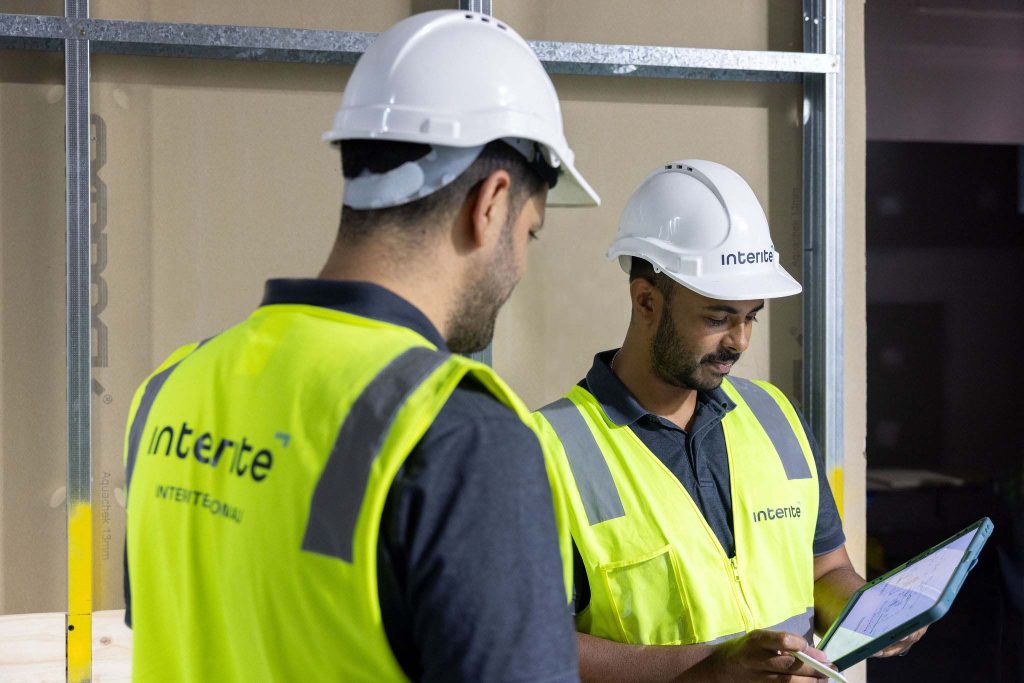
Engaging a specialist day hospital design and construction partner at feasibility stages means progressing a derisked project which is backed by cost, programme and approval certainty.
Right from site selection, we assess whether a site is viable for a class 9a development, saving you time and money before scope, budget or programme conversations even begin.
Feasibility estimates are derived from decades of experience, and genuine healthcare construction cost data, not commercial benchmarks adjusted with a contingency margin. And the full regulatory landscape – AusHFG compliance, state health licensing, NHMRC infection prevention and control frameworks, and planning authority requirements – informs scope and budget.
For organisations evaluating a day hospital opportunities, whether a greenfield development, tenancy fitout, or expansion of an existing facility, Interite offers the depth of day hospital expertise that this building class demands.
Get in touch with our team to discuss how we can support your project from site selection and feasibility through to completion.
References: