
Share
Contributors
Amanda Goonetilleke, Senior Interior Designer
Early in 2026, our team delivered a new dermatologist practice in Melbourne, for Laser Dermatology. We transformed a 612m2 two level tenancy, into a sophisticated specialist medical suite which supports medical, surgical and cosmetic treatments alongside a premium patient experience. The project showcases how thoughtful spatial planning and creative design can transform a challenging brief into a distinctive healthcare environment.
We sat down with Senior Interior Designer, Amanda Goonetilleke, to explore the thinking behind the project. From spatial planning and specialised equipment integration, to crafting a considered patient experience.
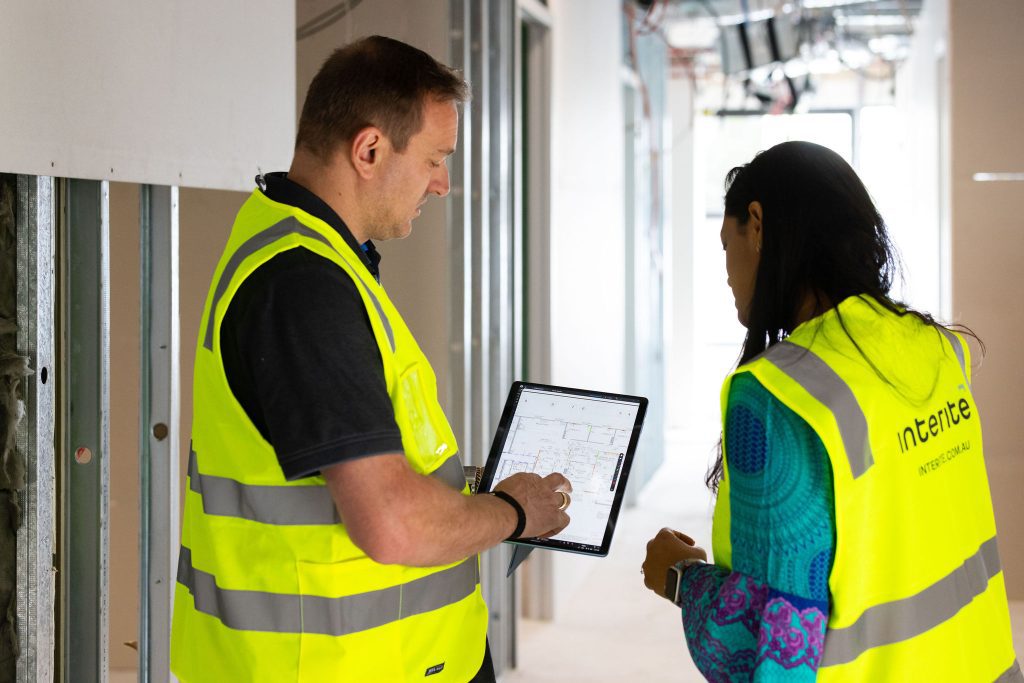
The brief was to relocate and expand the practice into a larger space that could accommodate Laser Dermatology’s growing patient base, with more consult and procedure rooms than their existing tenancy.
The client wanted an environment that felt professional but warmer than a traditional medical clinic, without leaning too far into luxury aesthetic. It’s located in Box Hill within a busy medical precinct and the clinic serves a broad, mid-range demographic, so striking that balance was important.
Key priorities were maximising natural light in consult spaces, optimising patient flow and operational circulation, and accommodating specialised laser equipment with significant power demands. To get across all of this, we worked closely with the client to understand their dermatology workflows in depth. The technical and operational requirements that came out of those conversations directly informed the zoning and layout across both levels.
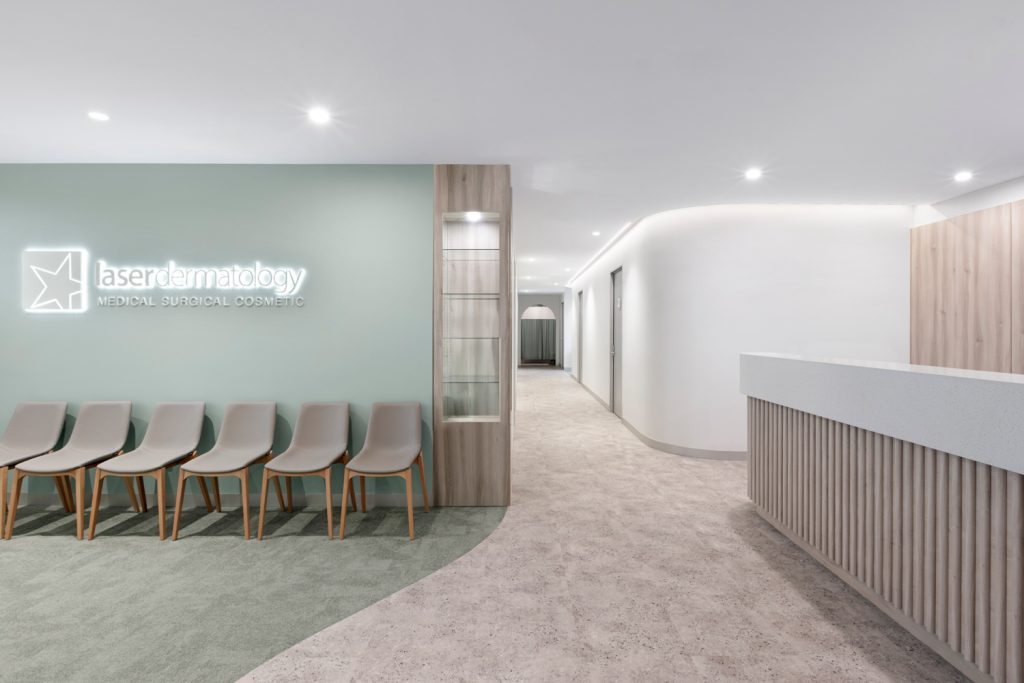
The design solution centred on dividing the two levels by function, general dermatology on level 1 and cosmetic treatments on level 2. Despite operating across two levels with two reception areas, the experience feels like one cohesive clinic with consistent use of materials and finishes across both levels. The level-split actually helps streamline patient flow and clearly separate the different arms of the business.
On level 1, we retained three existing consult rooms from the previous medical fitout and redesigned them to suit Laser Dermatology’s needs. Natural light was a key driver, as it’s essential for accurate skin checks, so consult rooms were positioned on the perimeter to capture window light, with procedure rooms placed in the centre. The floorplan also separates two procedure rooms and a recovery bay from patient consult spaces, improving flow for both staff and patients.
Level 2 had the opposite lighting requirement; cosmetic laser rooms needed blackout blinds and matte materials to prevent light leakage out and reflections in. A central core containing the stair, lift, and amenities naturally divides the floor into two zones: the larger side for patient treatments, the smaller for staff and admin. To make the most of a constrained footprint, the staff lunchroom was designed as a flexible space that also functions as a seminar and workshop room.
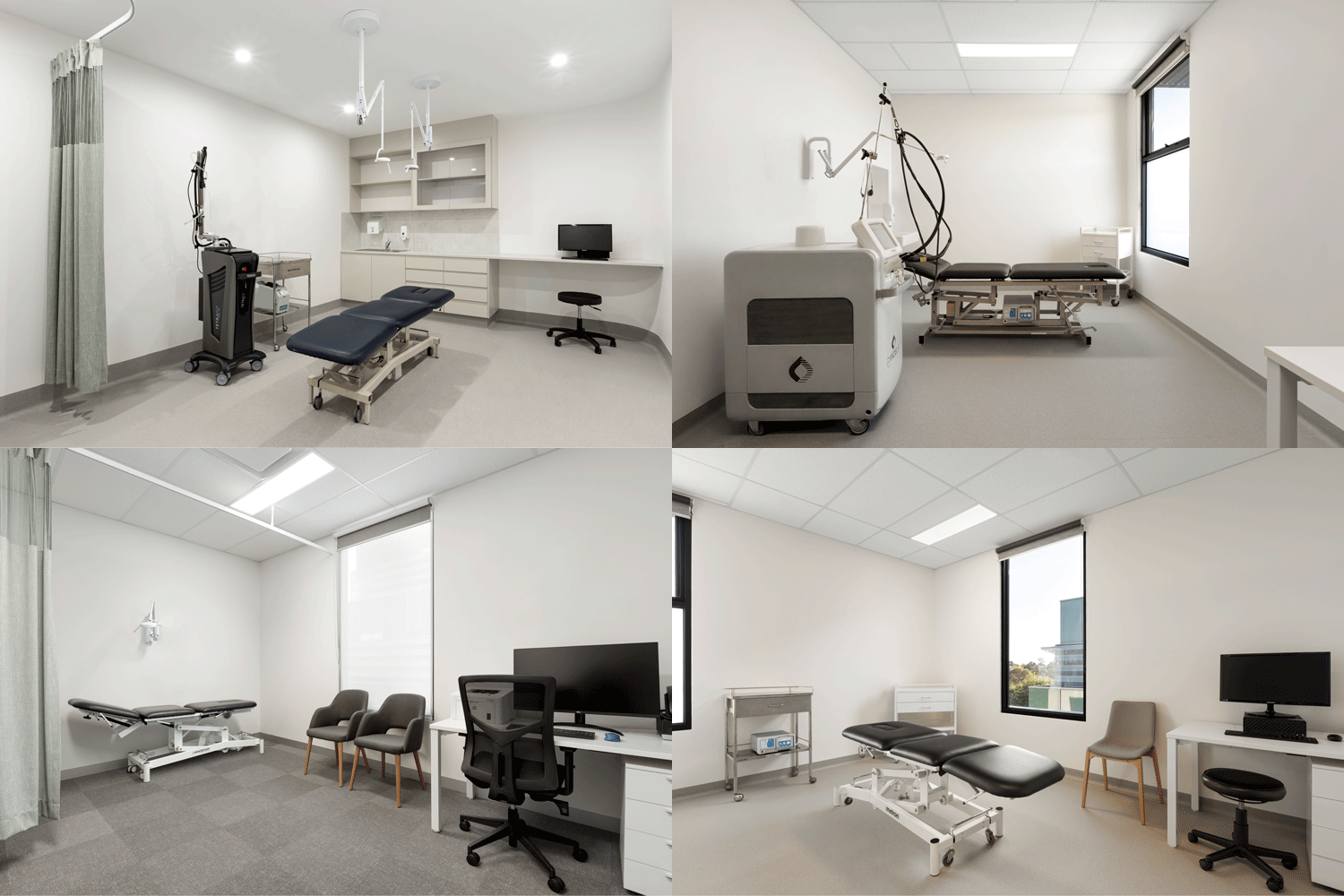
The most challenging technical requirements centred around the equipment. Not just what it was, how it moves, operates, and integrates into each space.
Laser treatment rooms demand a higher level of technical planning than standard medical suites. Beyond the specialised window treatments and carefully planned circulation, the equipment itself drives many of the design decisions, as we mapped the equipment journey alongside the staff and patient journeys. In the cosmetic treatment rooms, the laser machines need to circulate entirely around the treatment bed, so layouts were designed with that movement in mind, eliminating tripping hazards while keeping the space functional.
We also future-proofed the consultation rooms for potential laser use. Unlike the cosmetic treatment rooms where the bed sits centrally, consultation beds are typically positioned in a corner, so we ensured there was enough space to reposition the bed to the centre, should a doctor need to use a laser machine.
Power infrastructure was another significant challenge. A 32-amp requirement is more than double the 10–15 amp loads that standard medical fitouts are designed for, so the site required substantial cabling upgrades. By identifying this early through client workshops and integrating it into the design strategy from the outset, we were able to plan around it effectively on both levels.
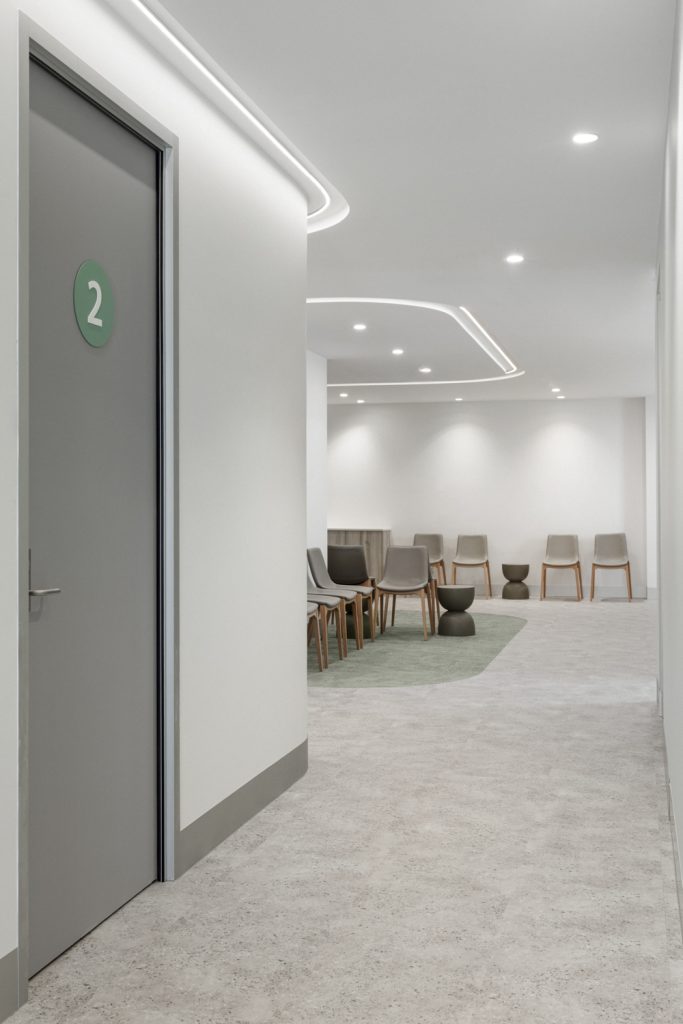
The patient journey was articulated through a combination of floor finishes, curved walls, lighting and services zoning across both levels.
The more obvious consideration was the tenancy split across both levels. Level One focuses on general dermatology with more space allotted for examination and procedure rooms. Level Two is a much more narrow footprint. It’s dedicated to cosmetic laser treatments, with it’s own reception area as well as a discrete alcove for patients, which provides them a level of privacy in-between treatments. Level two also offers space for a staff kitchen, and offices, distinctly removed from the patient area’s through a separation by the base building lift shaft.
Across both levels, floor finishes were a deliberate wayfinding and zoning tool. We used anti-static, medical-grade carpet in consult rooms to create a warmer, more welcoming first point of contact. In contrast, the procedure rooms and cosmetic treatment rooms use sheet vinyl, which was coved up the wall for infection control and clinical purposes. In high-traffic circulation areas, we chose vinyl plank with a terrazzo finish which is durable, easy to clean, and visually distinct from the clinical zones. The different floor finishes dictated the function of the space as well as contributed to wayfinding.
Curved walls and flushed plasterboard ceilings in the front of house areas integrated feature LED lighting to further accentuate the smooth direction of travel, as the design intended. With the use of material offering both functional and aesthetic cues as patients move through the space.
The standout element is the bold use of teal, which is uncommon in medical spaces. We were given the flexibility to creatively reinterpret the brand within the built environment through colour. Within this restrained palette, the brand’s signature teal is expressed as a tonal family and strategically applied to zoned areas throughout. Light teal accents clinical spaces, mid-tone teal supports wayfinding in transitional zones, and deep teal defines feature areas and signage backdrops. Paired with light timber and vinyl finishes, the palette brings warmth and distinction to the space.
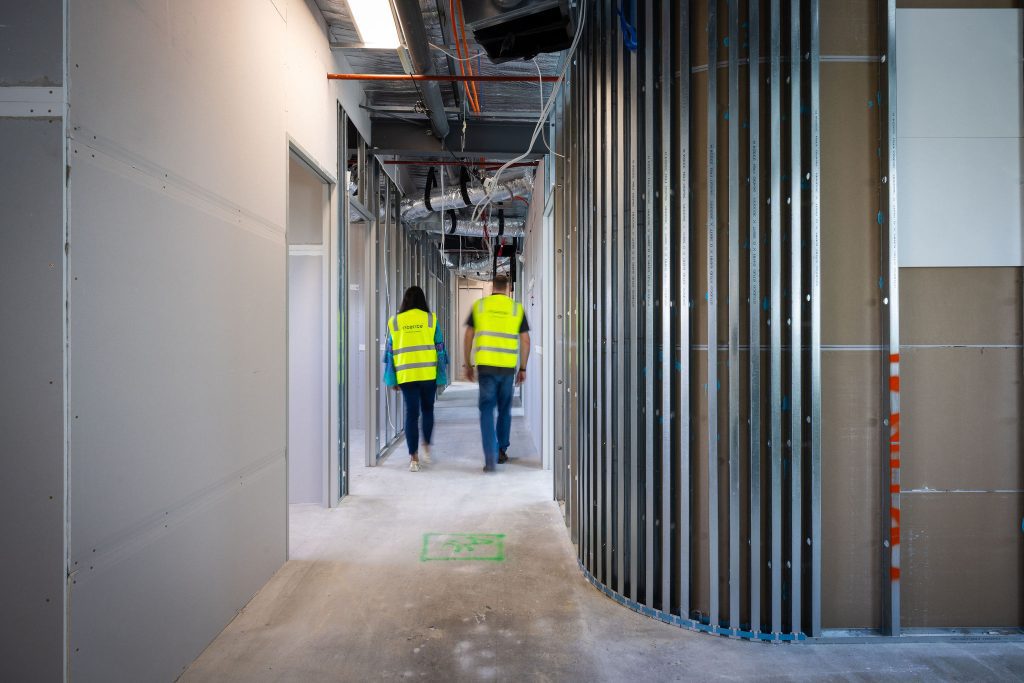
As the brief evolved and stakeholder requirements expanded, space constraints required careful management. We approached this through strategic planning and flexible layouts, maximising functionality and enabling key area’s to support multiple uses while maintaining operational efficiency.
In general, each new site comes with it’s own constraints, however these are not always seen as problems to overcome, but rather design drivers. For laser dermatology, the narrow floor plate on level two helped inform floor plan zoning of staff and patient areas. On level one, three existing consult rooms became anchor points for the layout strategy, and a split-level tenancy became an opportunity to thoughtfully separate different service streams while maintaining a unified patient experience.
As we continued to problem solve site ‘constraints’, the design became more efficient, and more responsive to the actual needs of the space. The result is a clinic that feels distinctive, considered, and true to the brand, without compromising on the technical and operational demands of a specialist dermatology practice. That balance is what good medical design should achieve.